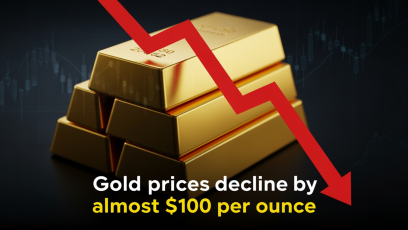
Precious metals took a pronounced hit on Tuesday, March 3, 2026, as both gold and silver reversed course following weeks of record-breaking gains. Gold was trading at $5,161 per ounce as of 10:00 a.m. Eastern Time — a decline of $177 from the prior session — while silver fell to $82.46 per ounce at 8:45 a.m. ET, representing a steep drop of $11.80 from the same time on Monday.

In the pre-dawn hours of Saturday, February 28, 2026, coordinated US and Israeli airstrikes — codenamed Operation Roaring Lion and Operation Epic Fury respectively — struck military installations, leadership compounds, and nuclear-linked facilities across Iran.

A special Sunday report of The Gold Forecast

In a watershed moment for U.S. trade policy — and by extension, global commodity markets — the Supreme Court delivered a 6-3 ruling on February 20 that struck down President Donald Trump's sweeping emergency tariffs, finding they exceeded his legal authority under the International Emergency Economic Powers Act (IEEPA).

Gold advanced Wednesday, gaining approximately $18, or 0.34%, to trade at $5,194 per ounce, while silver posted a more pronounced move, rising $1.63, or 1.87%, to $89.14. Analysts attribute the rally in precious metals primarily to trade policy uncertainty stemming from the ongoing constitutional standoff between the Trump administration and the Supreme Court.

Gold prices retreated in early trading Tuesday as investors locked in gains following a rally driven by U.S. tariff uncertainty and escalating Middle East tensions. New York gold futures slipped nearly 2% to around $5,118 per ounce, as a rotation into U.S. Treasuries temporarily overshadowed traditional safe-haven demand for the metal.

Gold posted a sharp monthly high on Monday, climbing $117, or 2.29%, to $5,248 per troy ounce, as a confluence of legal, political, and geopolitical pressures sent investors rushing toward safe-haven assets. The rally underscores gold's enduring appeal in an environment where policy uncertainty has become the defining feature of global markets.

Gold surged past $5,100 per ounce on Friday, testing monthly highs amid one of the most turbulent weeks for global trade policy in recent memory. The catalyst was a landmark Supreme Court ruling striking down reciprocal tariffs — a decision that initially sent the dollar lower and bullion sharply higher. Any relief, however, was short-lived.

With very little emerging news today affecting the gold markets let us take a look back at the major drivers that brought gold to the precipice of $5,000 per ounce this year and last.

Geopolitical Uncertainty

Gold futures reclaimed the psychologically significant $5,000 threshold on Wednesday, with the April contract advancing $98.40, or 2.01%, to $5,005 at the time of writing — a meaningful technical victory that spot prices have thus far been unable to replicate.